The Hidden Costs of Dual Eligibility: Why 12 Million Americans Face Complex Health Challenges
Explore the financial and health landscape of 12 million dual-eligible Americans enrolled in both Medicare and Medicaid, highlighting key spending trends.
Understanding the Dual-Eligible Population
Approximately 12 million Americans currently navigate the complex intersection of Medicare and Medicaid. These dual-eligible individuals often face significant health hurdles, frequently reporting fair or poor health status compared to those enrolled in only one program. Navigating two distinct systems often results in fragmented care, requiring robust support for daily activities. While Medicare acts as the primary payer for medical and post-acute services, Medicaid functions as a vital safety net, covering premiums and cost-sharing requirements. Of this population, 8.6 million qualify as "full-benefit" enrollees, gaining access to essential services like long-term care, dental, and vision, while 3.5 million remain "partial-benefit" recipients focused on premium assistance.

Disproportionate Spending and Enrollment Trends
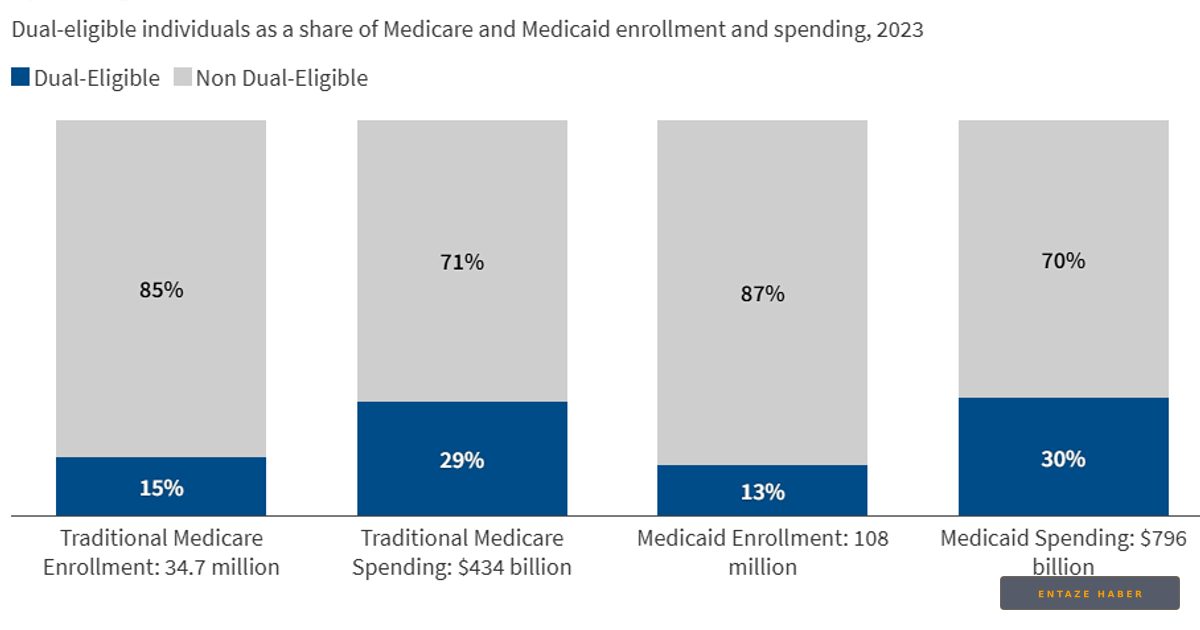
Nationally, dual-eligible individuals account for 21% of total Medicare beneficiaries and 13% of all Medicaid enrollees. However, these figures fluctuate significantly depending on the state. For instance, in Washington D.C., New York, Connecticut, and Louisiana, these individuals represent at least 30% of the Medicare population. This group commands a disproportionate share of federal and state resources. Although they make up only 15% of the traditional Medicare population, they are responsible for 29% of its total spending, equating to $127 billion. Similarly, they account for 30% of total Medicaid spending despite representing only 13% of enrollment.

The Impact of Chronic Conditions on Costs
Health outcomes for dual-eligible individuals are heavily influenced by the prevalence of chronic conditions. Research indicates that 57% of full-benefit and 56% of partial-benefit dual-eligible individuals manage five or more chronic conditions. This is a stark contrast to the 47% of other Medicare beneficiaries and the mere 2% of Medicaid-only enrollees who report the same level of complexity.
Spending trends reveal a direct correlation between the number of chronic conditions and financial outlays. For full-benefit dual-eligible individuals in traditional Medicare, average annual costs jump from $3,955 for those with no chronic conditions to $40,341 for those managing five or more. Medicaid spending follows a similar trajectory, largely driven by the high cost of long-term care services, which are typically excluded from Medicare coverage. Because over 60% of those utilizing long-term care are dual-eligible, this segment remains a primary driver of state Medicaid expenditures.
Recent Developments
Policymakers and healthcare stakeholders are closely monitoring these latest updates regarding dual-eligible spending to refine long-term care strategies. As breaking news in the healthcare sector continues to highlight the fiscal pressures on state programs, the need for integrated care models becomes increasingly urgent. You can follow all developments instantly on MedicareTicker.com.
Related Topics
🔹 Medicare Advantage 🔹 Medicaid Policy 🔹 Chronic Disease Management 🔹 Healthcare Spending 🔹 Long-Term Care 🔹 Dual Eligibility 🔹 Health Equity
Comparisons News
This category provides a comprehensive look at the intersection of government-funded health programs, offering live updates on policy shifts. MedicareTicker.com delivers the latest news and essential breaking news analysis to keep beneficiaries informed about their coverage options.
Frequently Asked Questions
Who qualifies as a dual-eligible individual?
Dual-eligible individuals are those enrolled in both Medicare and Medicaid. They fall into two categories: full-benefit recipients who receive additional services like vision and long-term care, and partial-benefit recipients who receive help primarily with Medicare premiums.
Why is spending higher for dual-eligible individuals?
Spending is higher because these individuals generally have more severe chronic health conditions than the rest of the population. Additionally, they often require long-term care services that Medicare does not cover, forcing Medicaid to pick up the substantial costs.
How do chronic conditions affect healthcare costs?
As the number of chronic conditions increases, so does the utilization of medical services. Data shows that for full-benefit dual-eligible patients, costs can be nearly ten times higher for those with five or more chronic conditions compared to those with none.