FDA-Mandated Studies Reveal Increased Blood Clot Risk for Rheumatoid Arthritis Drug Olumiant
New FDA-mandated post-marketing studies indicate a higher venous thromboembolism (VTE) risk for Baricitinib (Olumiant) in RA patients, potentially leading to label updates.

FDA-Mandated Studies Reveal Increased Blood Clot Risk for Rheumatoid Arthritis Drug Olumiant
The pharmaceutical landscape for rheumatoid arthritis treatment is under scrutiny following recent disclosures from mandatory post-marketing surveillance. Data presented at the European Alliance of Associations for Rheumatology's (EULAR) annual meeting in London indicate that Baricitinib, marketed as Olumiant, a Janus kinase (JAK) inhibitor, did not meet noninferiority criteria when compared to tumor necrosis factor (TNF) inhibitors regarding the risk of venous thromboembolism (VTE). This information emerged from studies mandated by the U.S. Food and Drug Administration (FDA) as a prerequisite for the drug's 2018 approval for rheumatoid arthritis.
Elevated VTE Risk Uncovered
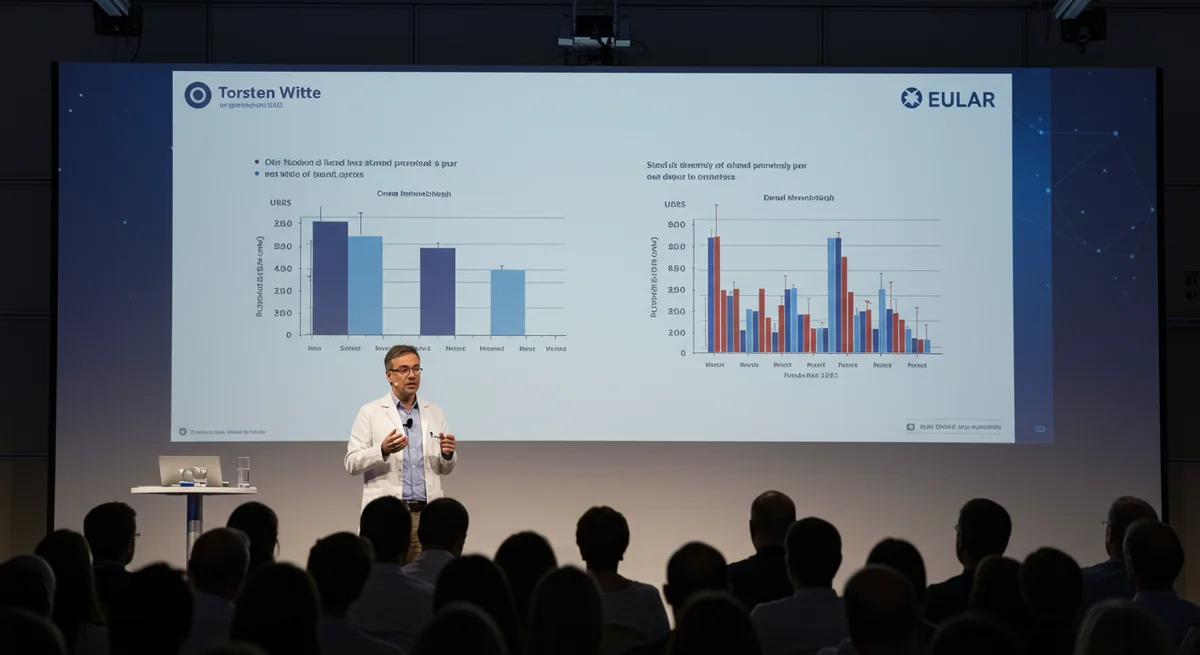
Dr. Torsten Witte, a medical expert from Hannover Medical School in Germany, conveyed these findings. He reported that participants receiving Baricitinib experienced VTE events at a rate of 2.5%, contrasting with a 1.7% rate among those administered adalimumab (Humira) or etanercept (Enbrel). This translated to a hazard ratio of 1.61 (95% CI 0.969-2.660) for the time elapsed until a patient's first VTE incident. While this difference did not achieve statistical significance, the FDA-approved study protocol stipulated that the upper confidence interval bound for noninferiority must not exceed 1.8. The observed upper bound significantly surpassed this threshold, as highlighted by Dr. Witte to attendees at the fully-attended late-breaking abstract session at EULAR.
Contextualizing Safety: Broader Risk Profile
Olumiant already carries a prominent boxed warning concerning the potential for VTE, alongside warnings for major cardiovascular events, specific infections, and malignancies. These existing cautionary statements primarily stemmed from a presumed class effect observed in the ORAL Surveillance study involving tofacitinib (Xeljanz), which was the pioneering JAK inhibitor to gain FDA endorsement. That particular study was a requirement for Pfizer, Xeljanz's manufacturer, after initial clinical trials hinted at elevated risks when juxtaposed with TNF inhibitors like adalimumab.
Despite the VTE findings, the new investigations did deliver some reassuring news for Eli Lilly, the company behind Baricitinib. No indication of heightened risk was detected for major cardiovascular incidents, overall mortality, or opportunistic infections. Dr. Witte's report also noted a modest and statistically non-significant increase in cancer rates, with a hazard ratio of 1.270 (95% CI 0.853-1.890) when compared to TNF inhibitors. However, serious infections were clearly elevated, showing a hazard ratio of 1.323 (95% CI 1.040-1.681). Dr. Witte clarified that the global pandemic heavily influenced the latter, attributing the increase predominantly to COVID-19 infections, given that the studies occurred during that period. Interestingly, Baricitinib itself received temporary authorization for COVID-19 treatment during the pandemic. It is also important to acknowledge that cardiovascular risks are an inherent component of rheumatoid arthritis. The systemic inflammatory nature of the disease is well-documented to burden RA patients with a greater vascular disease incidence than their age-matched general population counterparts, consequently leading to increased overall mortality.
Rigorous Study Design and Patient Selection
Eli Lilly initiated two distinct yet structurally similar trials to fulfill the FDA's mandate: one based in the United States, designated RA-BRANCH, and another encompassing an international patient population, named RA-BRIDGE. Both trials employed a 1:1:1 randomization scheme, assigning patients to either 2 mg/day or 4 mg/day of Baricitinib, or to one of the two TNF inhibitors (adalimumab or etanercept). The selection of the specific TNF inhibitor was determined at individual study locations; for instance, etanercept sees more widespread use in Europe. Given that Baricitinib is an orally administered medication while anti-TNF biologics require injection, blinding participants to their treatment arm was not feasible. Anti-TNF agents were dosed in accordance with country-specific labeling guidelines.
Enrollment criteria mandated active rheumatoid arthritis and the presence of particular risk factors for VTE, such as a history of a previous event, an age of 60 years or older, or a combination of obesity or overweight status with an age range of 50-59 years. This strategic patient selection aimed to maintain a manageable enrollment size while ensuring sufficient statistical power to identify potential variations in VTE risk.
A total of 3,640 individuals were enrolled and received treatment across the studies. The original protocol stipulated that the trials would conclude upon the occurrence of 123 primary VTE events. However, the FDA agreed to terminate the study once 82 events were recorded, determining that further continuation would likely not alter the principal findings. Dr. Witte's presentation integrated data from both trials, and for computing overall adverse event risks, the two Baricitinib dosage groups were combined.
Notably, the analysis revealed no discernible disparity in VTE risk between the two Baricitinib dosages. Dr. Witte and his colleagues computed hazard ratios of 1.704 for the 2 mg dose and 1.688 for the 4 mg dose (95% CI 0.943-3.079 and 0.968-2.943, respectively), both relative to the TNF inhibitor group. It may offer some comfort that, despite enrolling a population enriched for VTE risk, the actual occurrence of these events remained infrequent. Across both Baricitinib doses, 60 events were recorded among 2,433 participants over 7,694 patient-years of exposure, compared to 20 events in the TNF inhibitor group involving 1,207 participants over 3,830 patient-years.
Balancing Efficacy with Safety Concerns
The international study also encompassed several "exploratory" efficacy endpoints within its protocol, which yielded favorable outcomes for Eli Lilly. Specifically, the 4 mg dose of Baricitinib demonstrated significantly superior benefits compared to the TNF inhibitors across multiple measures (P <0.001 for each). For ACR70 responses, indicating a 70% reduction in symptoms according to American College of Rheumatology criteria, the rates were 11.7% for 2 mg, 21.6% for 4 mg, and 14.5% for anti-TNF treatments. Similarly, for achieving remission as defined by a Clinical Disease Activity Index score of ≤2.8, the figures were 9.0% for 2 mg, 17.6% for 4 mg, and 11.8% for anti-TNF. Furthermore, for a 28-joint Disease Activity Score below 2.6, another indicator of remission, the results showed 22.2% for 2 mg, 34.4% for 4 mg, and 26.5% for anti-TNF. The 2 mg dose, however, did not achieve comparable significant improvements over TNF inhibitors.
In his concluding remarks, Dr. Witte emphasized that these comprehensive data should "contribute to individualized benefit-risk assessments," underscoring the necessity for clinicians to weigh both the efficacy and safety profiles when prescribing.
Latest Updates on this Story
Breaking news regarding Baricitinib's safety profile continues to emerge as regulatory bodies assess the implications of these new findings. We are providing the latest updates on potential label changes and clinical guidance, offering current news to help patients and healthcare providers stay informed. You can monitor all live updates on this story in real-time on MedicareTicker.com.
Related Topics
🔹 Medicare Part D Coverage 🔹 Rheumatoid Arthritis Medications 🔹 JAK Inhibitor Safety 🔹 FDA Drug Approvals 🔹 Venous Thromboembolism Prevention 🔹 Eli Lilly Pharmaceuticals 🔹 EULAR Conference Highlights 🔹 Drug Post-Marketing Surveillance
About MedicareTicker News
MedicareTicker.com is the leading independent resource for comprehensive news and analysis on health insurance, Medicare policies, and pharmaceutical developments affecting senior health. Our coverage provides in-depth, objective reporting on new drug findings, regulatory updates, and their impact on patient care and access, ensuring our readers are always informed on critical health topics.
Frequently Asked Questions
What is Baricitinib (Olumiant) and what are these new findings about?
Baricitinib (Olumiant) is a Janus kinase (JAK) inhibitor approved in 2018 for treating rheumatoid arthritis. New FDA-mandated post-marketing studies have revealed that it did not demonstrate noninferiority to TNF inhibitors regarding the risk of venous thromboembolism (VTE), indicating a higher VTE incidence in patients taking Olumiant.
How significant is the increased VTE risk compared to other RA treatments?
The studies showed a 2.5% VTE rate for Baricitinib users versus 1.7% for those on TNF inhibitors, translating to a hazard ratio of 1.61. While not statistically significant, this ratio exceeded the FDA's predefined noninferiority threshold, suggesting a clinically relevant elevation in risk.
What are the implications for patients currently taking Baricitinib (Olumiant)?
Patients currently on Baricitinib should discuss these findings with their healthcare provider. The drug already carries a boxed warning for VTE, and these new data will likely contribute to individualized benefit-risk assessments by clinicians, potentially leading to updated treatment guidance.
Does this study also indicate other new safety concerns for Baricitinib (Olumiant)?
The studies found no increased risk for major cardiovascular events, overall mortality, or opportunistic infections. There was a statistically insignificant rise in cancer rates, but serious infections were clearly elevated, largely attributed to COVID-19 infections during the study period.