Supreme Court Upholds Generic Drugmaker's 'Skinny Label' Defense in Landmark Patent Dispute
The Supreme Court unanimously sided with Hikma Pharmaceuticals, affirming its right to use 'skinny labels' for generic drugs. This ruling impacts patent law and drug accessibility.
High Court Affirms Generic Manufacturer's Rights in Patent Battle
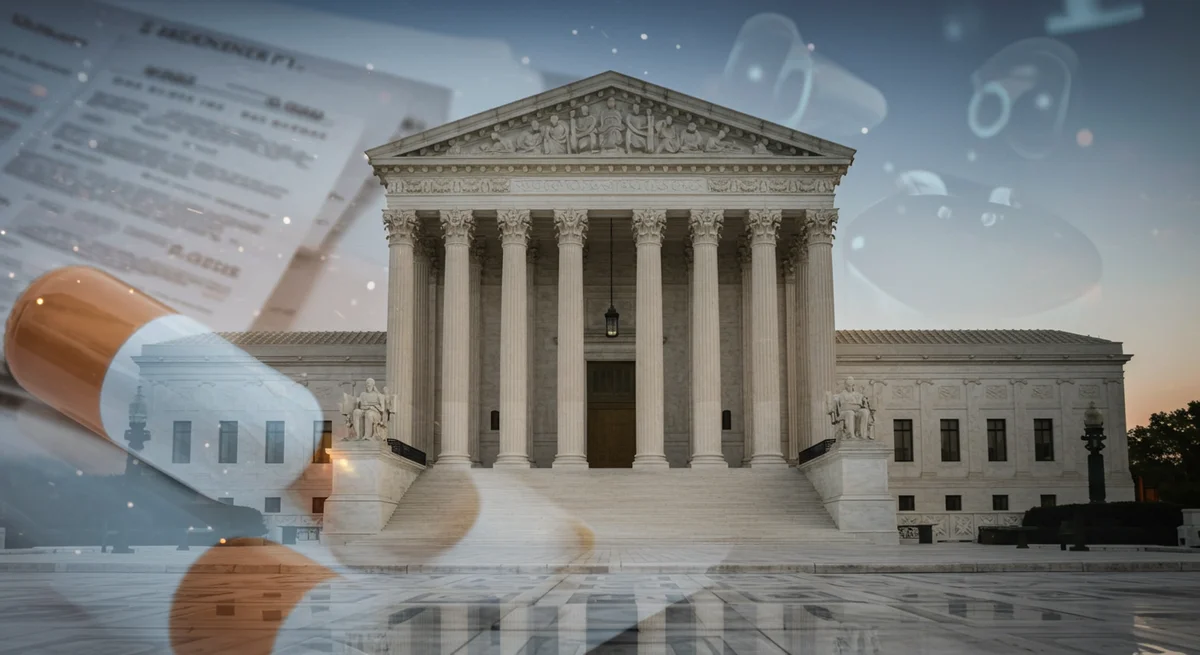
The nation's highest judicial body, the Supreme Court, has unanimously ruled in favor of Hikma Pharmaceuticals, a generic drug manufacturer, in a significant patent infringement case. The decision, delivered on Thursday, found that Amarin Pharma, the brand-name drug's patent holder, had not presented sufficient evidence to substantiate its claims of active inducement of patent infringement by Hikma. Consequently, the case has been referred back to a lower court for further proceedings.
Justice Ketanji Brown Jackson, writing for the unanimous Court, stated, "Amarin has failed to state a claim for active inducement ... so its complaint cannot withstand Hikma's motion." The judgment continued, "We therefore reverse the judgment of the federal circuit and remand the case for further proceedings consistent with this opinion."
The Genesis of the Legal Battle: Vascepa and Generic Entry
The legal dispute, formally known as *Hikma Pharmaceuticals v. Amarin Pharma*, centers on Hikma's introduction of its generic version of icosapent ethyl (marketed as Vascepa by Amarin) in 2023. Hikma's product was launched with a restricted indication, echoing the original 2012 approval for the branded drug: its use, alongside dietary adjustments, to lower triglycerides in adults suffering from severe hypertriglyceridemia (defined as levels equal to or exceeding 500 mg/dL). Notably, the generic version did not include the broader indication approved in 2019 for Vascepa.
At the heart of the contention was whether Hikma's actions—such as referring to its product as a "generic version" of the brand-name drug and referencing publicly available information about Vascepa, including its total sales figures in investor materials—could be construed as actively inducing medical practitioners to infringe upon Amarin's patents by prescribing the generic for unapproved, patented indications.
Decoding the "Skinny Label" Provision
Under the framework of the federal Hatch-Waxman Act, which governs the generic pharmaceutical industry in the United States, generic drug manufacturers are explicitly prohibited from promoting their products for uses protected by patents. However, the Act permits them to advertise for unpatented uses. This distinction is achieved through what is commonly known as a "skinny label," a term explained by the Supreme Court itself in a "questions presented" report concerning the case.
During the oral arguments held in April, Deputy Solicitor General Malcolm Stewart, representing Hikma, articulated the potential chilling effect of the lower court's prior ruling in Amarin's favor. Stewart argued that such a decision would imply, "you can get FDA approval of your skinny product label. But as soon as you put that product into commerce, and you say anything about that product, anything -- you call it a generic version, even if you have disclaimers -- you can be sued." He concluded that this scenario "sends a terrible message to the generic industry."
Legal Arguments Unpacked: Inducement vs. Industry Practice
Michael Huston, arguing on behalf of Amarin, contended that other generic manufacturers of icosapent ethyl had successfully adhered to the restrictions imposed by the Hatch-Waxman Act without issue. Huston specifically highlighted Hikma, stating, "Hikma alone was the one who described its product as 'AB rated' for 'hypertriglyceridemia,' even though that product is not approved for that distinct medical condition." He clarified that "AB rated" signifies the FDA's designation for a generic drug deemed therapeutically equivalent to its brand-name counterpart.
He further asserted, "Hikma alone repeatedly [referred to] Amarin's brand name, Vascepa, just at the moment when that name was synonymous in the market for treating cardiovascular [disease]." Huston maintained that these specific statements and other actions by Hikma, which were not employed by other generic competitors, provided reasonable grounds for the lawsuit.
In her decision, Justice Jackson directly addressed Amarin's objections regarding Hikma's statements. She noted that Amarin "finds fault in Hikma's statements describing its product as 'generic Vascepa' or the 'generic equivalent of Vascepa' in the prelaunch press releases." However, Jackson underscored the industry norm, explaining, "But as we have explained, it is 'normal industry practice' to 'truthfully describe' a generic drug as 'equivalent' to the brand-name comparator ... We decline to put generic manufacturers between a rock and a hard place by turning adherence to the law and industry standards into building blocks for illegal conduct."
Future Proceedings and Claims of New Evidence
Huston also suggested that should the Court not rule in Amarin's favor and dismiss the case, it would be "especially important for the court to allow the case to proceed back on remand." He elaborated that "since the federal circuit [decided] the case ... extensive discovery has occurred. Millions of documents have been exchanged ... and that has revealed substantial new evidence of Hikma's intent to infringe [the patent]," indicating Amarin's desire to amend its original complaint to the lower court.
Conversely, Charles Klein, the attorney representing Hikma, dismissed this assertion. "Just to be clear, there is no such evidence," Klein declared. He further stated that there is "no evidence that Hikma somehow intended its ... press releases to induce infringement, or its online product catalog to induce infringement. Zero evidence."
Latest Updates on this Story
This breaking news decision by the Supreme Court carries significant implications for the pharmaceutical industry, particularly concerning generic drug accessibility and patent enforcement. Ongoing legal discussions and potential amendments to Amarin's complaint will shape the future trajectory of this case. You can monitor all live updates on this story in real-time on MedicareTicker.com.
Related Topics
🔹 Generic Drugs 🔹 Supreme Court Decisions 🔹 Pharmaceutical Patent Law 🔹 Hatch-Waxman Act 🔹 Drug Pricing and Accessibility 🔹 Intellectual Property Rights 🔹 Medicare Prescription Drug Coverage
About MedicareTicker News
MedicareTicker.com provides comprehensive, objective news and analysis on all facets of Medicare policy, health insurance, and the pharmaceutical landscape impacting seniors. Our coverage of topics like generic drug patent disputes aims to keep our readers informed on critical developments shaping healthcare access and costs. We are the leading independent resource for these vital domains.
Frequently Asked Questions
What was the Supreme Court's ruling in the Hikma v. Amarin case?
The Supreme Court unanimously ruled in favor of Hikma Pharmaceuticals, stating that Amarin Pharma failed to adequately demonstrate that Hikma actively induced patent infringement with its generic version of Vascepa. The case has been remanded to a lower court.
What is a "skinny label" and how does it relate to this case?
A "skinny label" refers to a generic drug's labeling that omits patented uses of the brand-name drug while still allowing for advertising of unpatented uses. In this case, Hikma's generic Vascepa only carried the original, more limited indication, utilizing a skinny label strategy.
What is the significance of the Hatch-Waxman Act in this context?
The federal Hatch-Waxman Act regulates the generic drug industry, balancing brand-name drug patent protection with generic drug access. It permits generic manufacturers to launch products with skinny labels for unpatented uses, which was central to Hikma's defense in this lawsuit.
How does this decision impact the generic pharmaceutical industry?
This Supreme Court decision reinforces the ability of generic drug manufacturers to use "skinny labels" without automatically being accused of patent infringement, thereby potentially encouraging more generic competition and contributing to lower drug costs.