Why Your AI Chatbot and Social Media Feed Might Be Jeopardizing Your Health
A new KFF poll reveals that individuals lacking a trusted doctor and those relying on social media or AI for health advice are prone to believing vaccine myths.
The Digital Health Trap
A recent KFF Tracking Poll highlights a concerning trend in public health: reliance on non-traditional information sources is fueling the spread of vaccine misinformation. The data indicates that individuals who lack a primary care provider they trust are significantly more susceptible to believing false claims regarding immunization. This vulnerability extends to frequent users of social media and artificial intelligence chatbots, who demonstrate a higher propensity to accept medical inaccuracies as truth.

Trust Deficits and Misinformation
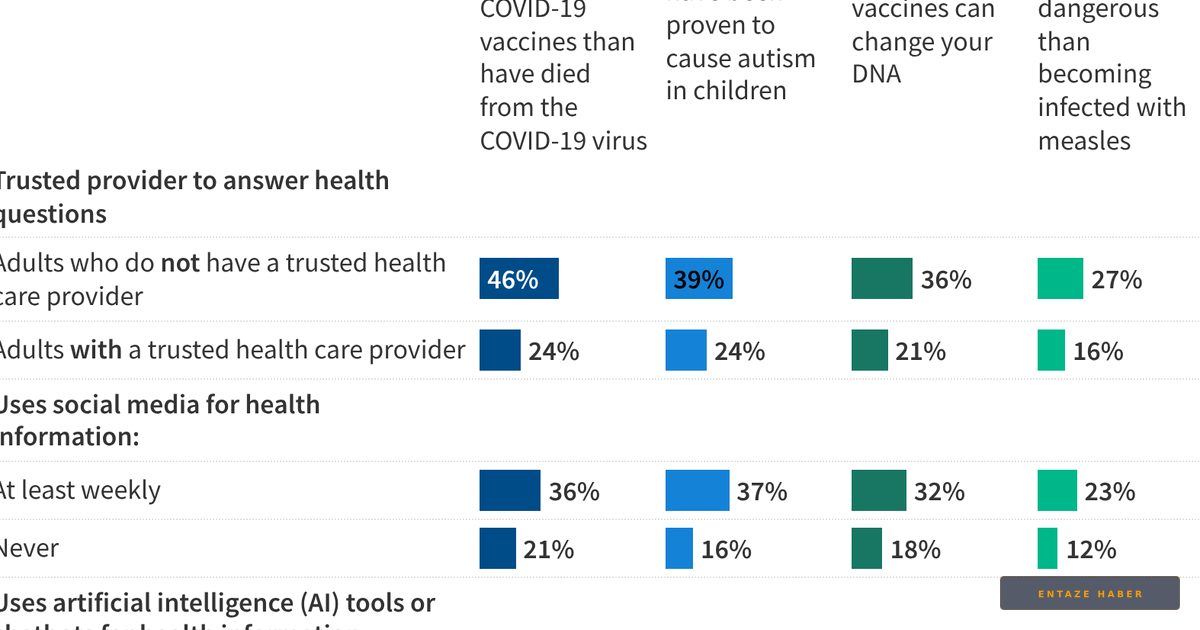
The gap in medical literacy is stark. Among adults who report having no trusted health provider to consult for medical guidance, approximately 39% incorrectly believe that the MMR vaccine is linked to autism in children. In contrast, only 24% of those with a trusted physician hold this erroneous belief. These findings remain consistent even when adjusting for variables such as age, race, education, political affiliation, and insurance coverage.

The Role of AI and Social Media
Digital platforms are playing an increasingly complex role in public health perception. The survey found that more than one-third of individuals who engage with social media (37%) or AI chatbots (35%) at least once a week for health-related queries fall for the same MMR-autism myth. This is roughly double the rate found among those who avoid these digital tools for medical information.
Persistent Myths and the Malleable Middle
While public awareness of specific myths varies, the persistence of false narratives remains a challenge. For instance, while the belief that mRNA vaccines alter human DNA dropped by 9 percentage points since April 2025, other myths, such as the claim that measles vaccines are more dangerous than the disease itself, have held steady at 29% since 2024. The study identifies a "malleable middle"—nearly half of the public remains uncertain about the veracity of these claims, caught between conflicting information and lacking definitive guidance.
Impact on Parental Decisions
Parents who delay or skip recommended vaccinations for their children are particularly prone to these myths. They are twice as likely as parents who maintain up-to-date vaccination schedules to endorse false claims. Specifically, 57% of those who delay vaccines believe the discredited link between MMR and autism, compared to 30% of those who stay up to date. Similar disparities exist regarding COVID-19 vaccine mortality, mRNA DNA-altering claims, and measles vaccine safety.
A New Way to Categorize Beliefs
KFF researchers have introduced a new typology to categorize these beliefs. While 55% of the population are classified as "myth deniers," roughly 8% are "consistent myth believers." The remainder, approximately 31%, reside in a "mixed middle," characterized by a lack of certainty and inconsistent responses across various health claims. The survey was conducted between May 7 and May 31, 2026, reaching 2,480 U.S. adults with a margin of error of plus or minus three percentage points.
Recent Developments
Public health experts are closely monitoring the impact of digital media on medical literacy, as breaking news regarding vaccine safety continues to circulate. These latest updates serve as a reminder that the shift toward AI-driven health advice requires more scrutiny in a live news environment. You can follow all developments instantly on MedicareTicker.com.
Related Topics
🔹 Public Health 🔹 Vaccine Safety 🔹 Artificial Intelligence 🔹 Medical Misinformation 🔹 Healthcare Access 🔹 Digital Literacy 🔹 KFF Research
State-news News
The State-news category provides breaking news and the latest updates on health policy and public opinion across the United States. MedicareTicker.com delivers live coverage on how national trends impact local communities and individual health decisions.
Frequently Asked Questions
Does having a primary care provider affect vaccine myth belief?
Yes, the data shows that people without a trusted provider are significantly more likely to believe common vaccine myths. A consistent relationship exists between having a reliable medical contact and the ability to distinguish fact from fiction.
Are social media users more likely to believe health misinformation?
Research indicates that frequent social media users are roughly twice as likely to believe false vaccine claims compared to those who do not use these platforms for health information. This suggests that digital information environments may lack the necessary filtering to prevent misinformation.
What is the "malleable middle" in vaccine belief?
This group represents approximately 31% of the public who are uncertain about the truth of various vaccine myths. They often provide a range of "probably true" or "probably false" answers rather than showing strong conviction either way.